 25th
February 2008
25th
February 2008
 Germany
fears that it may have moved toward the top of
al-Qaeda’s list of targets. An increasing number of
messages on jihadi websites call for an attack on German
soil. Simultaneously, there seems to be a “new quality”
in the Islamic propaganda, in the words of Heinz Fromm,
president of the Bundesamt für Verfassungsschutz
(Federal Office for the Protection of the Constitution,
or BfV), Germany’s domestic intelligence agency.
Messages and videos, including specific instructions for
the building of bombs, are now directly posted to
websites in German and in Arabic with German subtitles.
According to Fromm, this strengthening of al-Qaeda’s
internet offensive has been observed for the last year
(Die Welt, February 8). There is a consensus among
members of the government and the intelligence community
that the domestic security situation has deteriorated.
“There are indications that, apart from the Sauerland
attackers' plans, the odds are high that terrorists are
working on several other plans,” declared Bernhard Falk,
vice-president of the Federal Criminal Police (Die Welt,
February 8). Last July, Interior Minister Wolfgang
Schäuble warned: “We could be struck at any time”
(Spiegel Online, July 9, 2007).
Germany
fears that it may have moved toward the top of
al-Qaeda’s list of targets. An increasing number of
messages on jihadi websites call for an attack on German
soil. Simultaneously, there seems to be a “new quality”
in the Islamic propaganda, in the words of Heinz Fromm,
president of the Bundesamt für Verfassungsschutz
(Federal Office for the Protection of the Constitution,
or BfV), Germany’s domestic intelligence agency.
Messages and videos, including specific instructions for
the building of bombs, are now directly posted to
websites in German and in Arabic with German subtitles.
According to Fromm, this strengthening of al-Qaeda’s
internet offensive has been observed for the last year
(Die Welt, February 8). There is a consensus among
members of the government and the intelligence community
that the domestic security situation has deteriorated.
“There are indications that, apart from the Sauerland
attackers' plans, the odds are high that terrorists are
working on several other plans,” declared Bernhard Falk,
vice-president of the Federal Criminal Police (Die Welt,
February 8). Last July, Interior Minister Wolfgang
Schäuble warned: “We could be struck at any time”
(Spiegel Online, July 9, 2007).
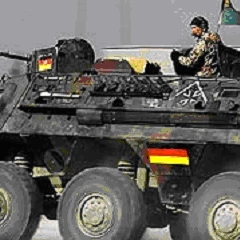
The main reason behind Germany’s new importance in
al-Qaeda’s agenda is the presence of German troops in
Afghanistan. A message published in the German-language
internet forum of the Global Islamic Media Front calls
for Islamist militants in Germany to act against their
government (Die Welt, February 8). As part of the
International Security Assistance Force (ISAF), Germany
currently has 3,200 soldiers deployed in Afghanistan,
mainly in the northern provinces and the capital city of
Kabul. On February 6, Germany committed to sending an
extra 200 soldiers to Afghanistan, remaining under the
maximum threshold of 3,500 soldiers allowed by a
parliamentary mandate (Reuters, February 6). Although
Germany has been a part of the NATO coalition in
Afghanistan since the beginning, the specific threat
against Europe and Germany has been growing in the past
few months—most notably since Osama bin Laden’s message
“To the Nations of Europe,” which called for attacks
against European countries (al-Jazeera, November 29,
2007).
At last week’s Munich Conference on Security Policy,
Secretary of Defense Robert Gates connected efforts in
Afghanistan with the terror threat in Europe: “What
would happen if the false success [the terrorists]
proclaim became real success—if they triumphed in Iraq
or Afghanistan, or managed to topple the government of
Pakistan? Or a major Middle Eastern government?” he
asked. “With safe havens in the Middle East, and new
tactics honed on the battlefield and transmitted via the
Internet, violence and terrorism worldwide could surge”
(Reuters, February 10).
German officials are well aware that a great part of
their country’s security depends on the situation in the
border region between Afghanistan and Pakistan.
Authorities are concerned about an increasing number of
German nationals travelling to Pakistan to receive
jihadi training in al-Qaeda’s camps. In March 2007, for
instance, Pakistan’s Inter-Services Intelligence (ISI)
seized 29-year-old Nihad C. from Pforzheim and
30-year-old Michael N. from Oberhausen, both
German-born. German investigators are convinced that
Nihad was looking for jihadi training (Spiegel Online,
March 14, 2007). The number of people involved in such
“jihadi trips” remains relatively low, although it is
expected to grow (Deutsche Welle, July 23, 2007);
therefore, it is hard to talk about a real jihadi
“network” in Germany. At the moment, it is instead more
accurate to talk about individual initiatives.
Concerns about terrorism—and more specifically
home-grown terrorism—are even greater since the release
of a new study commissioned by the German Interior
Ministry last December [1]. Based on interviews with
1,750 German Muslims, the authors conclude that radical
Islamism is a more important factor in Germany than
previously thought. The study finds that 40 percent of
the Muslim population has a “fundamentalist
orientation,” defined as strongly religious worldviews
and moral values. More worrisome is the authors’
discovery that 14 percent have “anti-democratic
tendencies” and 6 percent have “violent tendencies,”
which includes supporting violence in the name of Islam.
There are approximately 3.5 million Muslims in Germany,
mainly Sunnis from Turkey.
At first glance, this study appears to contradict the
results of a previous report from the BfV, which found
that there are approximately 32,000 Islamists in
Germany—accounting for one percent of the Muslim
population—who pose a potential security threat. Given
that there was one year between the two studies, the
discrepancies could be partly explained by al-Qaeda’s
internet offensive and the “new quality” in jihadist
propaganda. However, it is more likely that the
discrepancies are due to different methodologies and
criteria.
In order to cope with growing radicalization and the
threat of home-grown terrorism, Wolfgang Schaüble
advocates for changes in the Constitution. The German
Minister of the Interior suggests offering more freedom
to the intelligence, law enforcement and military
communities. Some of his ideas include preventive
detentions of suspects, the possibility of deploying
Bundeswehr (national armed forces) troops within the
country when necessary, targeted assassinations and the
clandestine seizure of private computer data via “Trojan
Horse” programs (Spiegel Online, July 9, 2007). Most of
the population is reluctant to accept these measures.
On January 24, the Federal Administrative Court in
Leipzig ruled that Germany’s foreign intelligence agency
Bundesnachrichtendienst (BND) could bug the telephones
of suspected terrorists even when there is no immediate
threat to Germany (Deutsche Welle, January 25). This
decision cited a previous case where a man was sentenced
to jail in Düsseldorf in 2005, based on a telephone
conversation in which he was heard offering his services
as a suicide bomber.
Another recent success story proves how internet
monitoring is a key aspect of counter-terrorism efforts
in Germany. On February 13, Thaer Alhalah, a 33 year-old
Jordanian, confessed to a German court that he had
participated in online discussions about setting up a
training camp for terrorists in Sudan (North German
Broadcasting, February 14). Three weeks earlier, alleged
ringleader Redouane El Habhab, a 38 year-old
German-Moroccan, had been sentenced to five years of
imprisonment for setting up a terrorist network in Sudan
and aiding an Iraqi group with links to al-Qaeda
(Reuters, January 24). It was the first time that
evidence had been obtained from phone calls via the
Internet and used to convict someone in a German court.
Germany has had several successes in countering Islamist
terror in the past years. However, the threat is growing
and the intelligence services are requesting more power.
At the same time, politicians and the media alike have
voiced their concerns about Schaüble’s proposals to
modify the Constitution. In Germany, the memory of a
regime sliding toward dictatorship is still very alive.
The population does not seem willing to accept sending
more troops to Afghanistan—a recent poll shows that 85
percent oppose additional deployments (Reuters, February
6). Hence, the government is unlikely to meet U.S.
demands for an expanded mission despite a recognition
that the security of Germany depends greatly upon the
evolution of the situation in Afghanistan.
 |
 |


