 27th August 2008
 This was a last-minute
change of direction, after the US embassy in Tbilisi
said Tuesday, Aug. 26, that the two warships delivering
aid to Georgia Wednesday would put in at the Black Sea
port of Poti, irrespective of the Russian decision to
search all incoming cargoes.
This was a last-minute
change of direction, after the US embassy in Tbilisi
said Tuesday, Aug. 26, that the two warships delivering
aid to Georgia Wednesday would put in at the Black Sea
port of Poti, irrespective of the Russian decision to
search all incoming cargoes.
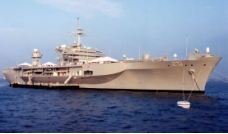
The two ships, the US
Coast Guard cutter Dallas and the command and
control USS Mount Whitney , docked at Batumi,
which is controlled by Georgia. The latter is equipped
with facilities for commanding sea, land and air combat
operations.
This abrupt U-turn
represents a striking American falling-back in the face
of Russia’s determined hard line. To avoid an inevitable
clash, the US has clearly gone back on its resolve to
break Russia’s illegal naval, ground and armored grip on
the Georgian port of Poti and to establish a Black Sea
naval presence. Moscow responded by ordering the Russian
navy to monitor NATO’s growing number of naval ships in
Black Sea.
Russian military chiefs
have charged that US aid consignments for Georgia by
sea, which could just as easily been delivered by air as
warships, were a cover for new arms deliveries to
Georgia. Russian checkpoints have been posted in and
around Poti for searches.
The first of the three US
aid warships, the USS McFaul , docked at Batumi
Saturday to avoid friction with the Russians at Poti.
Our sources report the vessel carried 50 Tomahawk cruise
missiles capable of striking land and sea targets.
In Moscow, military
sources report, Capt. Igor Dygalo, deputy commander of
the Russian Navy, announced Tuesday that the Moskva
missile cruiser would carry out a naval exercise on the
Black Sea.
The Russians are clearly
marking out their control of this inland sea against US
and NATO challenges. Capt. Dygalo said the Moskva
would practice its wire-guided weapons, communications
and missile guidance systems. The exercise will no doubt
interfere with the movements of NATO vessels, as clearly
intended.
Russian Dep. chief of
staff Gen. Anatoly Nogovitsyn spoke Monday, Aug. 25, of
nine Western vessels in the Black Sea - 2 American, 4
Turkish and the rest Polish and Spanish. He said their
presence was not a cause for concern.


