|
 London, 1 August (AKI) - The British
government on Tuesday for the first time made public its
official assessment of the threat of a terrorist attack,
warning that it is "severe," - the second highest in a
five level categorisation published for the first time on
the website of Britain's M15 intelligence service, as well
as that of Britain's interior ministry.
London, 1 August (AKI) - The British
government on Tuesday for the first time made public its
official assessment of the threat of a terrorist attack,
warning that it is "severe," - the second highest in a
five level categorisation published for the first time on
the website of Britain's M15 intelligence service, as well
as that of Britain's interior ministry.
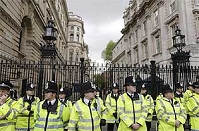 The
five level categorisation - low, moderate, substantial,
severe and critical - rationalises the previous seven
categories. The new system has seen the lowest possible
threat level upgraded from "negligible" to "low" and
echoes the five-level system of the United States. The
five level categorisation - low, moderate, substantial,
severe and critical - rationalises the previous seven
categories. The new system has seen the lowest possible
threat level upgraded from "negligible" to "low" and
echoes the five-level system of the United States.
Under the previous system of
categories - which was only available to the security
services - the national threat level had been set at
"severe general" since August 2005.
When interior minister John Reid
unveiled the new system last month, he warned it was "not
an exact science," and appealed for continued public
vigilance at all times.
Coordinated suicide bombings by
four young Muslim extremists carried out on 7 July 2005 on
London's transport system killed 56 people and injured
1,000. Despite an extensive and ongoing inquiry, police
have not charged anyone in connection with the attacks,
and have not established any links between the London
bombers and al-Qaeda or any terror organisation.
On 6 July, the day before Britons
prepared to mark the first anniversary of the London
attacks, one of the London bombers - Pakistani-descended
Shezad Tanweer, who died in the blasts with the other
three attackers - appeared in a video aired by Arab
satellite TV network Al Jazeera, warning of further
attacks. "The attacks will continue until you pull your
forces out of Afghanistan and Iraq," Tanweer said in the
video.
"What you have witnessed is only
the beginning of a string of attacks that will continue
and become stronger, " he warns. The video included a
statement from al-Qaeda's second-in-command, Ayman
al-Zawahiri, and an American, Gadahn, also known as Azzam
al-Amriki, who US authorities believe to be in charge of
al-Qaeda's propaganda.
Britain,
whose foreign policy is closely aligned with that of the
United States, continues to deploy thousands of troops in
Iraq and Afghanistan and is one of the few countries that
has not called for a ceasefire in Lebanon - where a
20-day-long Israeli military offensive has killed at least
least 600 people and injured over 1,500, triggering
international condemnation and the ire of the Muslim
world.
|


