 1st
September 2008
1st
September 2008
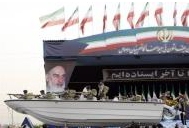 A
senior military commander warned on Saturday that any
attack on Iran would start a new world war, as Tehran
pressed on with its controversial nuclear drive despite
the risk of further UN sanctions.
A
senior military commander warned on Saturday that any
attack on Iran would start a new world war, as Tehran
pressed on with its controversial nuclear drive despite
the risk of further UN sanctions.
"Any aggression
against Iran will start a world war," deputy chief of
staff for defence publicity, Brigadier General Masoud
Jazayeri, said in a statement carried by the state news
agency IRNA.
Iran is under
international pressure to halt uranium enrichment, a
process which lies at the core of fears about Iran's
nuclear programme as it can make nuclear fuel as well as
the fissile core of an atom bomb.
"The unrestrained
greed of the US leadership and global Zionism... is
gradually leading the world to the edge of a precipice,"
Jazayeri said, citing the unrest in Afghanistan, Iraq,
Sudan and Georgia.
"It is evident that
if such a challenge occurs, the fake and artificial
regimes will be eliminated before anything," he said,
without naming any countries.
Iran does not
recognise Israel, which is often described by officials
in Tehran as a "fake regime" and President Mahmoud
Ahmadinejad has provoked itnernational outrage saying it
should be wiped off the map.
The United States and
its staunch ally Israel, the region's sole if undeclared
nuclear armed nation, accuse Iran of seeking atomic
weapons under the guise of a civilian nuclear programme.
Iran, a leading OPEC
member, has vehemently denied the allegations, insisting
its only wants to provide electricity for a growing
population when its reserves of fossil fuels run out.
The United States has
never ruled out military action against Iran over its
defiance of international demands for an enrichment
freeze, but so far is pursuing the diplomatic route.
Iran has repeatedly
vowed a crushing response to any attacks and has flexed
military muscles in recent years by holding war games
and showing off an array of home-grown weaponry
including ballistic missiles.
Another top military
commander said Iran was prepared to "take the enemies
off-guard" and would unveil more weapons in case of an
attack.
"Some of the
equipment of our armed forces have been announced but
there are important things hidden whose effect would be
shown on the day (of any attack)," deputy army commander
Abdolrahim Mousavi told Fars news agency.
"Offensives are part
of the strategy of defence and if a country confines
itself to its borders it has set a limit and eliminated
part of its capability," he said.
During war games in
July which stoked international concern, aides to the
supreme leader Ayatollah Ali Khamenei warned that Iran
would target US bases and US ships in the Gulf as well
as Israel if it was attacked.
Iran also test-fired
its Shahab-3 missile which it says puts Israel within
range.
In recent months,
several Israeli politicians have talked of the
possibility of a preemptive military strike against
Iranian nuclear facilities to avoid any possibility of
Tehran acquiring an atomic weapon.
Iran has repeatedly
said it has no intention of halting enrichment despite
three sets of UN Security Council sanctions and US and
EU sanctions on its banking system.
Iran insists it has a
right to enrich uranium for nuclear fuel as a signatory
to the Non-Proliferation Treaty. It is currently
operating about 4,000 uranium enrichment centrifuges and
installing several thousand more.
However, the
country's first Russian-built nuclear power plant is yet
to come on line.
The Islamic republic
risks further sanctions for failing to give a clear
response to an incentives package offered in June by six
world powers in return for a halt to the sensitive work.
World powers offered
to start pre-negotiations with Iran during which Tehran
would add no more uranium-enriching centrifuges and in
return face no further sanctions.
The offer by
permanent Security Council members Britain, China,
France, Russia and the United States plus Germany
included trade incentives and help with a civilian
nuclear programme.


