 Ukraine fears that Moscow may try to use
its military power to reclaim the strategic peninsula
Ukraine fears that Moscow may try to use
its military power to reclaim the strategic peninsula
27th August 2008
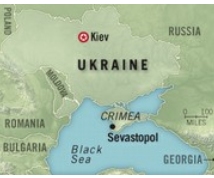 Russia's
invasion of Georgia is raising concern that the next
flash point may be Ukraine's Black Sea peninsula, the
Crimea, an area once part of Russia that still provides
a key warm-water port for the Russian Navy.
Russia's
invasion of Georgia is raising concern that the next
flash point may be Ukraine's Black Sea peninsula, the
Crimea, an area once part of Russia that still provides
a key warm-water port for the Russian Navy.
Moscow's relations with Ukraine have been
strained since the 2004 Orange Revolution, in which
pro-western Viktor Yushchenko won an election runoff
after hundreds of thousands of Ukrainians protested the
allegedly fraudulent victory of his Kremlin-backed
rival. Like Georgia's western-oriented leader,
Yushchenko has been pressing hard and very publicly for
his country to join NATO, a move that infuriates the
Kremlin. Next week, Vice President Dick Cheney is due to
visit Georgia and Ukraine as a high-profile sign of
Washington's support.
For the Russians, the Crimea is an issue
of strategic importance, even more than pride or
nationalism. Russia's Black Sea naval fleet is based at
Sevastopol, a city located at the tip of the Crimea
peninsula. Russia holds a lease to the naval base until
2017, though in recent years Ukrainian politicians have
made clear that they are eager for the Russian Navy to
pull out.
And just as Georgia's leader unwisely
challenged Moscow's interests in the pro-Russian South
Ossetia enclave, the Ukrainians made a brief but
troubling show of standing up to Moscow over its Crimean
port. After Russian warships departed Sevastopol for
Georgia's Black Sea coast to support the Kremlin's
offensive, the Ukrainian administration announced new
restrictions on the fleet and threatened to ban the
ships from re-entering Ukrainian territory.
The Ukrainians backed down, but that is
not likely to be the end of the issue. Yushchenko said
at Ukrainian Independence Day celebrations on Sunday
that Ukraine is vulnerable and should push harder to
join NATO. "We need to accelerate our accession to the
European security system and improve our country's
defenses," he said. "Only these steps will effectively
guarantee our security and the inviolability of our
borders."
As a practical matter, the Georgian war
is likely to put full NATO membership on hold, probably
indefinitely, for Ukraine, as well for Georgia. All
along, the European members have resisted Washington
pressure to move quickly on their membership, fearful
that the western military alliance—with its collective
defense obligations—would risk being drawn into conflict
with Russia over old territorial disputes festering
since the breakup of the Soviet Union.
A recent poll by the Kiev International
Institute of Sociology of around 2,000 Ukrainians found
that 50 percent fear a war with Russia over the presence
of the Black Sea fleet in Sevastopol (35 percent said
there was no cause for concern).
The Crimea, while it has a majority
Russian-speaking population, has been under Kiev's at
least nominal control since 1954, when Soviet Premier
Nikita Khrushchev transferred it from Russia on the
grounds that it had better economic and transport links
with Ukraine. Russia had won the Crimea from the Tatars
in the late 18th century, and Sevastopol assumed a
vaunted place in Russian history; many Russian
schoolchildren read Leo Tolstoy's short stories about
Sevastopol.
Today, ownership has become a highly
emotive issue. Moscow Mayor Yuri Luzhkov was banned from
Ukraine in May after saying that Sevastopol, now a city
of 400,000, does not belong to Ukraine.
An overreaction, perhaps, but it's a
potentially dangerous topic for Ukraine. According to
the 2001 Ukrainian census, the most recent, around 60
percent of the 2 million inhabitants of the Crimea are
Russian, and around 25 percent are Ukrainian. Last week,
Russia denied reports that it has been distributing
Russian passports in the Crimea, as it has done in South
Ossetia and Abkhazia, two pro-Russian regions seeking
independence from Georgia. According to the Ukrainian
newspaper Express 24, 15,000 Sevastopol
residents, most in the military, hold Russian passports.
In Moscow, coverage of Georgia has so far
drowned out the rumblings in Ukraine, but some
Muscovites are clear where they stand. "No one in my
circle—and they're rather well educated—would say the
Crimea is Ukrainian territory. You could shoot them, and
they wouldn't say it's Ukrainian," said Yelena
Kamenskaya, a prosperous Russian teacher. She added: "We
all think it's going to be the next trouble spot."
As with Georgia, there is the prospect of
U.S. involvement. The head of Ukraine's National
Security and Defense Council is in Washington this week
for talks. And Vice President Cheney is traveling next
week to meet with leaders in both Ukraine and Georgia,
visits that may embolden Russia's hard-liners. In the
wake of Russia's move into Georgia, he declared that
"Russian aggression must not go unanswered."
Parliamentarians from United Russia,
Russia's ruling and virtually only party, see Yushchenko
as acting at the bidding of the United States—some going
so far as to cite the perceived influence of Cheney even
before his trip was announced. "It's not democracy when
a president carries out the orders of a vice president
of another country," said Sergei Markov, a United Russia
deputy.
Analysts have suggested that Yushchenko
is bolstering the specter of a rampaging enemy to boost
his own rock-bottom popularity ratings. And considering
the common historic and ethnic origins of Ukrainians and
Russians—closer than Russians and Georgians—ordinary
Russians would have a hard time coming to terms with a
war on Ukraine, says Fyodor Lukyanov, editor of the
magazine Russia in Global Affairs. "An armed
conflict between Russia and Ukraine would be a
catastrophe. The two peoples are so close that, from a
moral point of view, it's horrifying."


