 11th
February 2009
11th
February 2009
The bailout packages
aimed at shoring up financial markets in Europe are
getting increasingly expensive. A creeping depreciation
of currency is inevitable and state bankruptcies can no
longer be ruled out. Could the euro zone also fall
victim to the global financial crisis?
 “There’s
a rumor going around that states cannot go bankrupt,”
German Chancellor Angela Merkel said recently at a
private bank event in Frankfurt. “This rumor is not
true.”
“There’s
a rumor going around that states cannot go bankrupt,”
German Chancellor Angela Merkel said recently at a
private bank event in Frankfurt. “This rumor is not
true.”
Of course she’s right.
Countries can go bankrupt if they allow their deficit
spending to spin out of control and are no longer able
to service their interest payments. Merkel’s comments
can be read as a warning that countries need to keep
their deficit spending in check. The message is: If
governments go too far in trying to bail out companies
and the economy, they could face insolvency themselves.
And so far, national
governments have gone very far. Be it in the United
States or in Europe, the sums governments are having to
cough up to prevent the financial system from collapse
are staggering.
Germany alone has already
provided credit guarantees of €42 billion ($52.28
billion) to prevent the collapse of Munich’s Hypo Real
Estate, a bottomless pit that most now believe will have
to be fully nationalized. The only thing holding up such
a move is a legal provision in Germany that limits state
holdings in banks to 33 percent. Meanwhile, Germany’s
second-largest consumer bank, Commerzbank, has been
bailed out, with the state taking a one-quarter stake in
the company. And the recent fourth-quarter loss of €4.8
billion at Germany’s leading financial institution,
Deutsche Bank, suggests that it too may ultimately
require state assistance.
From
Inconceivable to Inevitable
The image is even bleaker
in the United States, where economist Nouriel Roubini
estimates that losses in the financial sector will total
$3.6 trillion. In the United Kingdom, the government has
partially nationalized the Royal Bank of Scotland and
Lloyds TSB — and many experts see a full nationalization
as inevitable.
There are few who would
disagree with such moves. Should large
systemically-vital banks go bust, the global financial
system would collapse. But how much can countries afford
to pay before the deficit-spending bubble bursts? An
unimaginable scenario? Less than a year ago, a
nationalization of banks in the US, Germany and Britain
would have been inconceivable. Today, even the US — the
home of unbridled capitalism — sees these moves as
inevitable.
The borrowing being done
by countries to finance the bailouts, economic stimulus
programs and shortfalls in tax revenues will create a
lasting burden. Worse, with the decline in the banking
sector continuing, it is unclear that such massive
spending will be effective. Especially when other, less
economically stabile countires surrounding Germany have
gone into a tailspin.
Take the example of Great
Britain. The country is on the brink of financial ruin.
Real estate is overvalued, private households are overly
indebted and its vast financial sector has been badly
hit by the crisis. Confidence in Britain’s ability to
overcome the economic turmoil is sinking by the day, as
evidenced by the precipitous decline of the pound, which
has almost reached parity with the euro. Just 13 months
ago, it was worth €1.40.
A Second Iceland
“I wouldn’t invest any
more money in Great Britain,” says American investor Jim
Rogers. And economist Willem Buiter, a former consultant
to the Bank of England, warns of the “risk that Great
Britain will become a second Iceland.”
One can also look to the
example of Italy, which is on track to join a rather
exclusive — and undesirable — club. At 106 percent of
gross domestic product, Italy will have the
third-largest national deficit in the world.
In a country that has
long had a solid savings rate, deficit spending hasn’t
proven to be a huge problem in the past. The greatest
challenge for the government had was luring people to
buy bonds at a set interest rate. The country’s finance
minister has described these investments as the “most
solid and secure thing available.” Of course, not
everyone shares that opinion at the moment —
particularly not the Italians themselves. One bond that
was floated in mid-January only found takers after the
government markedly increased the interest rate offered.
This year, Rome has to
pay back €220 billion in short-term bonds. Finance
officials have been quoted as saying that were a single
bond issue to find no takers, it “would be a disaster
for the state.” In December, Italian Labor Minister
Maurzio Sacconi warned that Italy could go bankrupt if
the country were no longer able to sell public bonds
because of the glut of offers in other countries. “It
would create a liquidity problem for paying salaries and
pensions and we would end up like Argentina.”
Great Britain as a second
Iceland, Italy as a second Argentina. Iceland today is
as a good as bankrupt, and Argentina actually became
insolvent in 2001. It’s no wonder then, that quotes like
that from government officials are making people
nervous. There has been no other time in history since
the end of the Great Depression that the risk of
national bankruptcies was this great in Europe as it is
right now.
The national budgets in
most of the European Union member states are in a
miserable state. Finance experts at the European
Commission in Brussels estimate that, this year alone,
deficit spending in the 16-member euro zone will total 4
percent of GDP, with that figure rising to 4.4 percent
next year. The euro Stability Pact, however, only allows
3 percent. The Commission estimates that in 2010, 17 EU
states will surpass this total. The list includes
countries like Germany (4.2 percent), France (5
percent), Spain (5.7 percent) and Britain (9.6 percent).
Ireland is expected to top the list with deficit
spending of an anticipated 13 percent.
These predictions, of
course, exist only on paper for the moment. But Austrian
Finance Minister Josef Pröll warns that “someday,
payment day will come.”
Euro Bonds?
Last week, Pröll and his
colleagues formulated a call for a change of course,
saying a coordinated fiscal stimulus was needed and that
it must include a “coordinated budget consolidation”
across Europe. Just how that might happen, though, is
unclear.
In a hearing before the
economic committee of the European Parliament last week,
EU Economics and Currency Commissioner Joaquin Almunia
was showered with questions for which he had few
answers. As a first step, he suggested that six to eight
countries should reduce their deficits. But he didn’t
suggest how they might go about doing that.
For some governments,
budget consolidation is the furthest thing from their
minds at the moment. Instead these countries are doing
everything they can to find ways of securing credit,
which is getting increasingly difficult. “Smaller
countries are being pushed out of the credit markets
because the larger countries are borrowing billions,”
members of parliament told Almunia. His response: That’s
true, but you still can’t “do away with capital
markets.”
In order to solve the
problem, Luxembourg Prime Minister Jean-Claude Juncker,
who is also his country’s finance minister, proposed
that the 16-member euro zone states should create common
“Euro Bonds.” Smaller countries praised the proposal,
but it met with instant rejection in Berlin.
Germany, so far, has been
able to borrow cheaply because it still has an excellent
credit rating. If the country were to fill its coffers
by floating Euro Bonds, it would have to pay €3 billion
more this year. Austrian Finance Minister Pröll also
seemed uninterested, dismissing the Euro Bonds as giving
carte blanche for creating new debt at the expense of
others.
Many European leaders
have been critical of Germany’s approach to the
financial crisis — it was slow to implement an economic
stimulus package and some derided Chancellor Angela
Merkel as “Madame Non.” But in Germany, the government
has been concerned about the risk of over-borrowing and
burdening future generations with debt. The government
has already abandoned its plan for a balanced budget by
2011, and Merkel has warned of the limits of Berlin’s
role in any bailout.
Merkel is concerned that
the bailouts will overstrain the government. After all,
if the government’s debt continues to rise, at some
point it will no longer be capable of paying the
interest. Already, 2009’s planned borrowing of €18.5
billion is higher than the previous year, and this week
the government is now in the process of approving a
second economic stimulus package that, combined with
other borrowing, could push 2009 deficit spending past
the €50 billion mark. No German government has ever had
to borrow that much money.
To ensure that future
generations aren’t saddled with massive debt, the plan
contains a provision that will funnel €1 billion a year
in revenues from Germany’s central bank, the Bundesbank,
that previously went into the government budget starting
in 2011. Currently, the Bundesbank pumps €3.5 billion a
year into the budget. Until 2012, any profits at the
bank exceeding €3.5 billion would go toward paying down
the growing national debt.
Most experts believe the
German government still has room to maneuver, but
further deficit spending may be inevitable and few know
how much will be needed. Berlin may soon have to
establish one or more so-called “bad banks” where
troubled financial institutions can park their bad loans
— a program that would require yet further government
borrowing.
A Real Test for the Euro
Zone
The government has
exercised a degree of caution in deficit spending in
recent years that has often been lacking in some other
EU states. And politicians in Berlin have been reluctant
to push through massive economic stimulus programs that
might encourage others to abandon any sense of fiscal
responsibility.
In the past, a handful of
EU member states borrowed and borrowed without giving it
a second thought. Now, they’ve been hard hit by the
current downturn because their credit ratings have been
lowered and they are now being forced to borrow at
higher interest rates. Spain, Italy, Ireland and Greece
have been particularly hard hit.
Countries that have to
borrow so expensively are threatened with constantly
rising interest rates that in turn increase their debt.
In response, credit ratings further lower ratings,
pushing interest rates even higher in what becomes a
vicious circle.
Market speculators create
additional pressures. The tensions could escalate even
further and create a real test for the euro zone.
The Euro Safety Net
But what would actually
happen if a euro zone member state went bankrupt? During
the next 24 months, for example, Greece will have to
come up with €48 billion in order to service old debts,
while at the same time plugging holes in its budgets.
If a country like Greece
became insolvent, it would be initially be spared of the
worst consequences of bankruptcy because of its
membership in the euro zone. The euro would lose some of
its value, certainly, but the Greek economy doesn’t play
huge role in Europe and the depreciation would be
limited.
The consequences for
Greece would also be limited. Because the currency would
remain relatively strong, there would be no crisis in
the retail sector, there wouldn’t be any consumer
hoarding and no black market — in other words, it
wouldn’t create an economic crisis any greater than the
one that would already exist. Nor would it lead to an
increase in unexmployment.
Under the protective
shield of the European Union, life in a bankrupt state
would be relatively comfortable. The more important
question, though, is how the EU would react.
Worst-Case Scenario
One scenario is that it
could declare Greece to be an exceptional case and
provide bridge loans in order to prevent the bankruptcy.
But it would have disastrous consequences. After all,
why would weak countries make any effort to balance
their budgets if they knew the EU would bail them out in
the worst-case scenario.
If the EU remained firm
against Greece, that would certainly be fair to the
member states who have practiced balanced budget
discipline in the past. But that would also be
politically untenable because it would drive investors
away from any country that showed even the slightest
signs of not being able to service its debt. They would
have to continue raising the interest rates on bonds,
and eventually the Greek virus would spread further,
driving other countries into bankruptcy.
In this highly
theoretical scenario, the euro would, indeed, collapse.
The currency could survive the bankruptcy of one member
state, but it couldn’t sustain a series of them.
Euro-skeptics have long
warned that tension inside the euro zone could destroy
the currency one day. They now feel their convictions
have been affirmed — even if the aforementioned
scenarios remain far from reality.
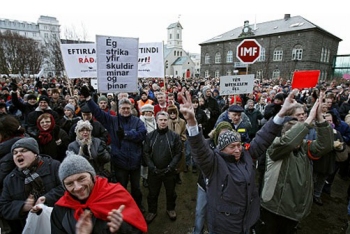
Iceland is as good as
bankrupt: Will other European countries follow?
Germany itself has
little trouble getting money. But even here, in light of
the multibillion euro shortfalls in the national budget,
investors are slowly starting to get nervous about
German bonds. Many uncertain investors are starting to
ask “what the future looks like for countries with AAA
ratings,” says Moody’s analyst Alexander Kockerbeck.
Experts at the US ratings company are already feeding
worst-case scenarios into their computers. In one, they
input test data for 2010 and 2011 assuming the economy
would shrink by 3 percent each year. In that model, the
national deficit rose quickly from today’s close to 70
percent to 80 percent of GDP.
“The interest burden
would be around 7 percent of government revenues,”
Kockerbeck said, saying Germany could still manage to
preserve its high credit rating. But if that figure got
up to 10 percent, the country might lose the best
rating, causing its financing costs to soar.
Competing ratings
agency Standard & Poors, which last week cut Spain’s
rating, holds a similar view. Analyst Kair Stukenbrock
last week confirmed Germany’s AAA rating. He also said
he currently “assumes that the German economy and
government budget can weather the current financial
crisis without losing its credit worthiness.”
Stangled by Interest Payments
In normal times,
assuming a country has a solid credit rating and a good
economy, borrowing is routine. Germany routinely floats
short- and long-term bonds that pay interest. They can
have a duration from anywhere between one day and 30
years. But some other countries, including Spain and
France, even issue 50-year bonds. They are mostly sold
through auctions — and the higher the price, the cheaper
it is for countries to borrow, but that also reduces
profits for investors.
Repaying that debt is
far more complicated. In the simplest case, the country
just pays back the debt. It’s extremely rare, of course,
for a country to do that. In most cases countries renew
their debt rather than repay it — and by doing so they
create new debt. Already today, the German government
must pay €43 billion a year in interest. It’s the
second-biggest chunk in the federal budget after social
expenditures.
But that could
quickly change. If, for example, interest rates were to
rise to their 1995 levels, the country would be faced
with an additional €20 billion in payments, and that’s
without factoring in any new debt. Of course, given the
nature of the current crisis, the debt burden will rise.
Nobody knows how high, nor how the country can eliminate
that debt before it starts to get strangled by interest
payments.
One way to pay down
debt, of course, is massive spending cuts and austere
savings probrams. That, though, is difficult. Much more
attractive is the inflation route. The state can just
print money and pay its bills. Or the central bank
prints money and pumps it into the economy. The currency
becomes devalued, but the state doesn’t care because
that makes it easier to pay off its debts.
No matter how a
country elects to pay down its debt, it’s the taxpayers
who are left to foot the bill in the end. Indeed, the
only time it is possible to repay the deficit by
government savings is during boom phases, periods when
the government can increase taxes, or if it can reduce
its expenditures.
The people also pay
the price of inflation because as the currency get
devaluated, prices increase.
Up until now, the
process has been subtle. Since the end of the 1990s, the
major central banks in the US and Europe have trippled
the volume of money in circulation. In recent months,
the volume of money in circulation in the US and Europe
has increased by almost half.
Universal Phenomenon
Central banks are
trying to use the flood of liquidity to prevent a
collapse of the global financial system and, as a
result, of economies. At the same time, they may also be
laying the path for the next crisis. Money is already
insanely cheap: the US Federal Reserve has sunk its key
interest rates to almost zero, and the European Central
Bank is already down to 2 percent. It is extremely
likely that interest rates will be lowered even further.
But if the bailout
packages take effect and the economy starts to rebound,
then central banks will again raise interest rates —
otherwise we would be threatened with a massive wave of
inflation and the next, even worse crisis, would be
inescapable. But the move may also lead many highly
indebted countries to go bankrupt.
In a study for the
International Monetary Fund, US economists Carmen
Reinhart and Kenneth Rogoff researched financial crises
of the last 800 years and concluded that state
bankruptcies were a “universal phenomenon.” Many
countries have, in fact, gone bankrupt more than once.
Between 1500 and
1800, France became insolvent eight times. Spain went
bankrupt seven times during the 19th century. Insolvency
is a common phenomenon in every period of history, they
concluded, and it would be erroneous to think that state
bankruptcies are a “distinctive feature of the modern
financial world.”
Nothing Is
Unimaginable Anymore
In most cases the
country’s coffers were wiped out by war. But in each
case, the countries managed to bring themselves back
from ruin. They proved to be incredibly resourceful in
using their connections to banks, companies and,
especially, the people.
The simplest solution
was for states to just outright refuse to pay back their
debts. In 1557, Spain’s King Philipp II refused to pay
his country’s debts after its expensive military battles
against the Dutch and the Ottomans. It was a decision
that seriously damaged lender banks in Augsburg,
Germany, and they never fully recovered.
Even after the
Revolution, France’s new regents had an even more
extreme. They expropriated property from churches, major
landowners and executed some lenders.
A similarly brutal
option was to go to war to in order to plunder occupied
areas. But such methods of budget consolidation tended
to only happen when things started to collapse. Even in
the old days, inflation was the preferred method of
dealing with debt. They created more money and
devaluated it. It’s a method that was adopted as early
as ancient Rome, where the Romans devaluated their coins
by using fewer precious metals in them. It became a
standard practice. In Vienna, the silver content in the
Kreuzer coin was reduced by 60 percent between 1500 and
1800 and the Ausgburg pfennig lost more than 70 percent
of its value.
Once paper money was
introduced, the process was further simplified, since
you could just print it. The first country to start
printing money on a grand scale was France in the 18th
century, when it needed to pay off the mountain of debt
accrued by Louis XIV. In times of crisis, French
governments ever since have fallen for this temptation.
The Warning
of Hyper-Inflation
In 1914, with the
start of World War I, the German Reich also began to
unpeg its currency from gold. Until then, anyone could
trade paper money for precious medals. Unpegging the
currenty meant that the amount of money in circulation
rose from 13 to 60 billion marks by the end of the war,
while the products on offer were reduced by one-third.
Prices skyrocketed.
The disastrous
development reached its peak in 1923 with
hyperinflation. The exchange rate at the time was 4.2
trillion marks to the dollar. Bank notes were printed in
130 private printing presses, often on one side only to
save ink. The only thing that could stop the mass
devaluation was to change currencies.
In November 1923, the
government issued the so-called Rentenmark. The previous
currency could be exchanged at a rate of 1 trillion
marks for 1 Rentenmark. Inflation quickly stopped.
People spoke of the “miracle of the Rentenmark.” But the
truth is that it wiped out the savings and investments
of large swaths of the German middle class as well as
wealthy people who had been forced to finance the war by
buying government bonds that had now been rendered
worthless. Banks and insurance companies also lost their
capital. The greatest winner, besides people who had
loans or mortgages they no longer had to pay back, was
the government. Its war debt shrank into insignificance.
These traumatic
events remain a part of the Germany’s collective memory
and they fuel a latent fear of hyperinflation here
today. Should people be afraid?
For the moment they
don’t need to be. Compared to many other countries,
Germany is well positioned to ride out the crisis. The
economy in recent years has been a lot stronger than
other EU members and it is not as dependent on the
financial sector as Great Britain. And unlike the United
States, it isn’t dependent on foreign lenders.
Iceland, for its
part, is already as good as bankrupt. In Eastern Europe,
a number of countries are wobbling — Latvia has already
had to request aid from the IMF and the Eastern European
Development Bank. In the capital city of Riga, 40 people
were injured in a violent protest that took place on
Jan. 13.
Great Britain is also
in trouble. And if it weren’t for the protection that
their membership in the common currency provides them
with, some euro zone countries would be fighting for
financial survival right now. America, on the other
hand, is banking on the fact that it is still considered
stabile despite it’s enormous problems — and that the
Chinese still hold a huge chunk of their currency
reserves in US bonds.
So will things get
better? It would be an illusion to believe that
countries have learned from their past mistakes, US
economists Reinhart and Rogoff warn. In fact, another
state could go bankrupt at anytime and take its people
down with it.
In this crisis,
nothing is unimaginable anymore.


