 At
least 35 people were killed in 24 hours in the worst
spate of bloodshed yet this year.
At
least 35 people were killed in 24 hours in the worst
spate of bloodshed yet this year.
11th February 2009
 Mexico
suffered one of its worst days of drug violence this
year Tuesday, highlighting that, even as the Obama
administration turns its sights to Afghanistan and
Pakistan, a major policy challenge is burning right on
the border.
Mexico
suffered one of its worst days of drug violence this
year Tuesday, highlighting that, even as the Obama
administration turns its sights to Afghanistan and
Pakistan, a major policy challenge is burning right on
the border.
Agence France-Presse
reports that
at least 35 people were killed in 24
hours of drug-related violence in Mexico,
"one of the bloodiest days so far this year."
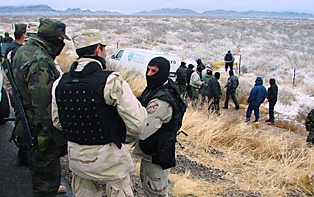
Tuesday, 21 people were killed in a
shootout between Mexico's army and gunmen in the
northern state of Chihuahua, a military spokesman said.
The standoff began when suspected drug
gang members kidnapped nine people in Villa Ahumada, 130
kilometers (81 miles) south of the violence-stricken
border city of Ciudad Juarez.
The Los Angeles
Times
explains
that "the region has been at the center of the war
between Juarez-based traffickers and rivals from the
northwestern state of Sinaloa. In May, dozens of
attackers stormed Villa Ahumada, killing the police
chief, two officers and three civilians. They also
reportedly hauled off 10 other people."
More than 5,000 people were killed
last year in
drug-related violence throughout Mexico, according to
MSNBC.
That violence may be
a world away from Afghanistan, Pakistan, and Iraq. But
increasingly,
it is beginning to look more and more
like the brutal bloodshed of those countries,
as Johann Hari, a correspondent for the London
Independent, writes in The Huffington Post.
Where in the world are you most likely to
be beheaded?... Where are hand grenades being tossed
into crowds to intimidate the public into shutting up?
Which country was just named by the US Joint Chiefs of
Staff as the most likely after Pakistan to suffer a
"rapid and sudden collapse"?
Most of us would guess Iraq. The answer
is Mexico. The death toll in Tijuana today is higher
than in Baghdad.
Yet some analysts
fear that with militancy in Afghanistan and Pakistan now
an administration priority,
Mexico is not receiving enough attention.
Ted Galen Carpenter, the vice president for defense and
foreign-policy studies at the libertarian Cato Institute
in Washington, writes in an editorial for The Houston
Chronicle:
While US leaders focus on Afghanistan,
Iran and other problems in distant regions, there is an
alarming security problem brewing right next door.
Violence in Mexico, mostly related to the trade in
illegal drugs, is spiraling out of control. Even worse,
it is increasingly apparent that the drug-traffickers
are winning their fight against the Mexican
government....
Indeed, Mexican drug gangs now operate in
numerous cities throughout our country. Cartel enforcers
have published lists of Americans, including police
officers, who are targeted for assassination.
President Barack Obama must put the drug
violence in Mexico at the top of his national security
agenda. While it is premature to describe Mexico as a
full-blown failed state, as some experts have done, the
situation has reached alarming proportions.
Underscoring that
concern, the Associated Press highlights the
chilling extent to which
drug violence is spilling right into the
US's backyard.
Just as government officials had feared,
the drug violence raging in Mexico is spilling over into
the United States.
US authorities are reporting a spike in
killings, kidnappings and home invasions connected to
Mexico's murderous cartels. And to some policymakers'
surprise, much of the violence is happening not in towns
along the border, where it was assumed the bloodshed
would spread, but a considerable distance away, in
places such as Phoenix and Atlanta.
Investigators fear the violence could
erupt elsewhere around the country because the Mexican
cartels are believed to have set up drug-dealing
operations all over the US, in such far-flung places as
Anchorage, Alaska; Boston; and Sioux Falls, S.D.
MSNBC adds:
"More than 200 American citizens have been killed since
2004 in Mexico's escalating wave of violence, amounting
to the highest number of unnatural deaths in any foreign
country outside military combat zones, according to the
US State Department."
As the fight against
drug cartels intensifies, there are growing calls for
Mexico's government to
ensure human rights,
as the International Herald Tribune reports.
Amnesty International said Monday that
Mexico glossed over human rights problems in its annual
report to the UN Human Rights Commission, adding to
criticism of President Felipe Calderón's army offensive
against drug cartels....
Since taking office in December 2006,
Calderón has dispatched tens of thousands of troops to
fight warring drug gangs. Amnesty said those troops were
implicated in 50 alleged incidents of unlawful killings,
rape, torture and arbitrary detention between January
2007 and June 2008.
Mexico has instituted new procedures for
training and screening police, but the government
reported in November that almost half of the country's
375,000 police officers failed security, psychological
or background tests.


